Spontaneous Generation experiment
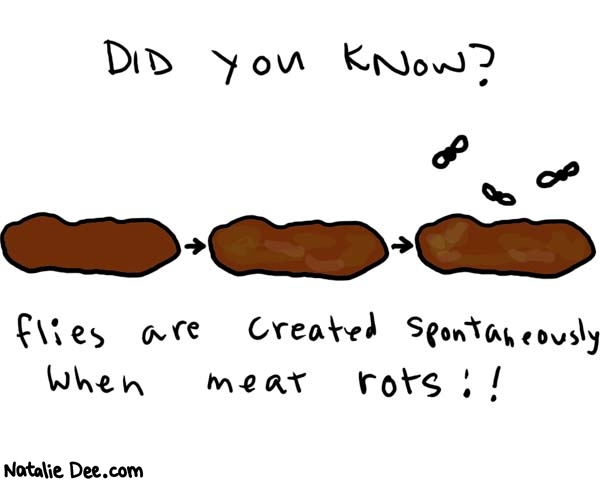
The abrupt and haphazard creation of maggots/flies from meat.
This belief prevailed the 17th century; it was "common notion" that when meat was left out, flies and or maggots would be "birthed".
Francesco Redi was an Italian naturalist, physician, and poet who debunked the theory of spontaneous generation.
To do so, he created an experiment that resembled the image below.

Three jars that each had meat had a paper cover, no cover, and gauze cover, respectively. Redi hypothesized that only the meat that had physical contact with the flies would "produce" maggots.
The hypothesis was correct.
Although each meat decayed, only containers (b) and (c) attracted flies; the open contact with air allowed the rotting smell to be transmitted and, therefore, be detected by the flies. Then, the flies would lay their eggs on the open meat/open gauze. In conclusion, the meat did not "birth" maggots (baby flies), the flies did.
The preexisting knowledge that accepted the spontaneous generation theory was no longer valid.
In the scientific world, it is only until another piece of knowledge replaces the prior that knowledge is accepted as "true".Science is always a changing and evolving field. New information will, more often than not, either build on or invalidate previous "truths". It is only until an individual challenges what is accepted as "true" that existing "truths" can be put to the test. Until then, however, what is accepted as knowledge will prevail.


No comments:
Post a Comment